Area of application

Lagerverwaltung

In der heutigen Geschäftswelt ist eine effektive Lagerwirtschaft von entscheidender Bedeutung, um die betriebliche Effizienz des Unternehmens zu steigern und Kundenanforderungen zu erfüllen. Um eine erfolgreiche Lagerwirtschaft zu erreichen, müssen Unternehmen die richtigen Tools und Technologien einsetzen, um eine nahtlose Integration ihrer Geschäftsprozesse zu gewährleisten. Zwei der wichtigsten Softwares für diese Aufgabe stellen Lagerverwaltungssysteme (LVS) und Enterprise Resource Planning (ERP)-Systeme dar.

Eine Lagerverwaltungssoftware unterstützt bei der Optimierung der Lagerverwaltung und eine ERP Software unterstützt dabei, Geschäftsabläufe zu rationalisieren. Im Endeffekt ist sowohl eine Lagerverwaltungssoftware, als auch eine ERP Software für den nahtlosen Ablauf der Lagerwirtschaft unabdingbar, da diese viele organisatorische Vorteile aufweisen und dabei helfen, Kosten einzusparen.

AvERP and warehouse management

A warehouse management system (WMS) is a software application that helps companies manage and optimize their inventory and stock movements. It provides companies with a central platform to… To monitor inventory, process orders, track deliveries, and increase the efficiency of warehouse movements.

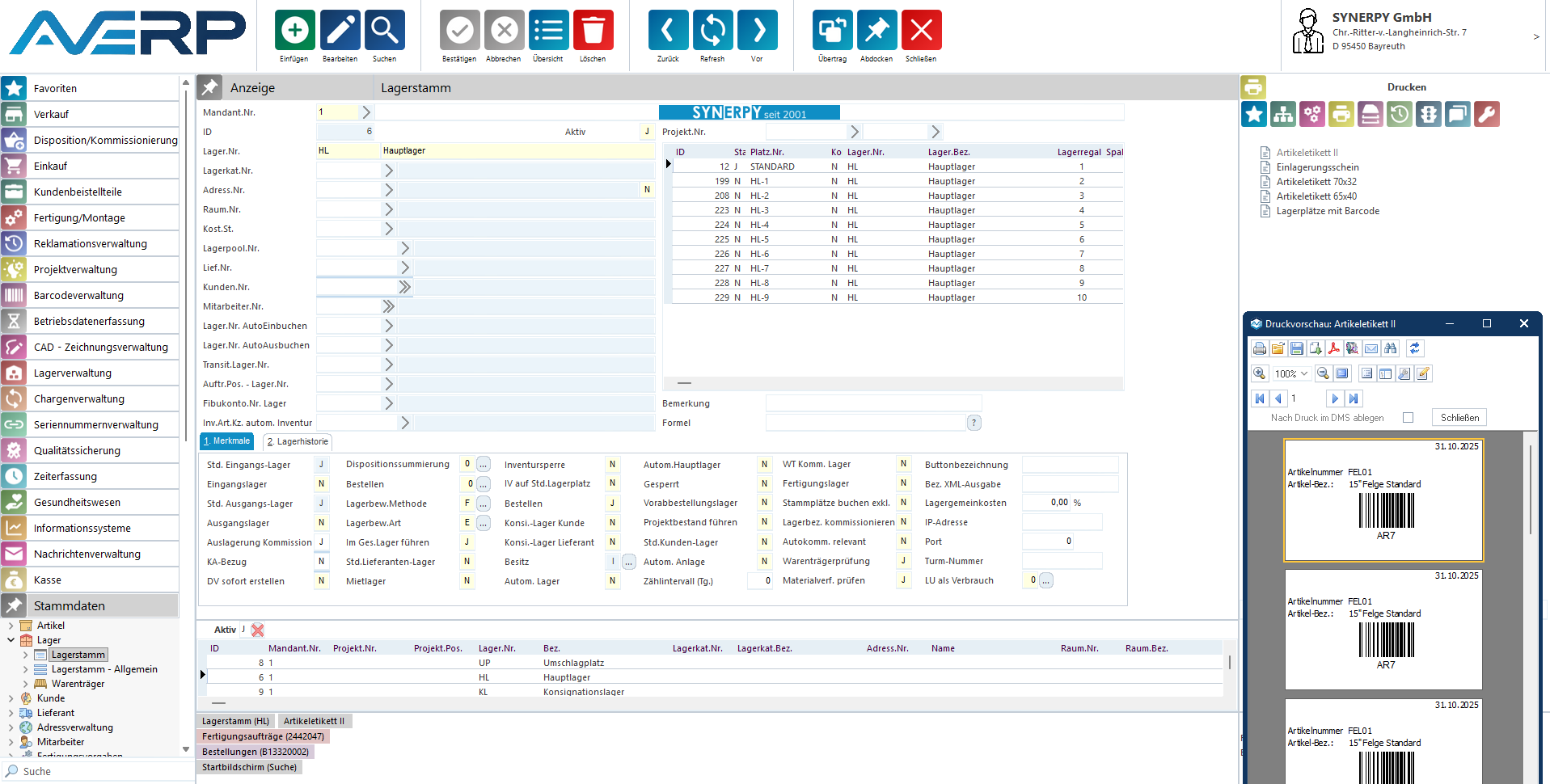
With AvERP, you have everything in one system. Various screens provide information about stock levels and make tracking products, managing orders and deliveries, conducting inventories, creating reports and forecasts simple and efficient.

In AvERP, warehouse management, customer relationship management and inventory control go hand in hand.

The licence-free ERP system for small and medium-sized enterprises.

WMS and ERP. What's the difference?

A warehouse management system (WMS) is a specialized software solution that focuses exclusively on managing inventory and warehouse processes. A WMS can include various functions such as inventory tracking, inventory management, storage location management, inventory reduction and optimization, as well as reporting and analysis.

An Enterprise Resource Planning (ERP) system for warehouse management, on the other hand, is a more comprehensive solution that not only encompasses the management of inventory and processes but also integrates other business areas such as finance, human resources, and purchasing. It is an integrated system that covers a wide range of business processes and enables the seamless integration of data and processes between different departments.

An ERP system like AvERP for warehouse management can contain similar functions to a WMS, but with extended functions, such as:

Furthermore, AvERP also offers better integration with other business areas, leading to a holistic approach to business process optimization.

Advantages of effective warehouse management

Cost saving

Effective inventory management enables companies to optimize their stock levels and thus reduce storage costs. Companies can avoid holding excessive inventory, which incurs unnecessary storage costs, or prevent shortages that can lead to unexpected expenses.

Customer satisfaction

Customers can be served quickly and reliably by ensuring the right products are available at the right time. This contributes to higher customer satisfaction and strengthens customer trust in the company.

Increased efficiency

By better managing their inventory and optimizing the movement of goods within the warehouse, companies can reduce the number of manual processes and thus save time and costs.

Risk reduction

Risks associated with warehousing goods can also be reduced through effective inventory management. Companies can ensure they maintain sufficient stock to avoid shortages, but not so much as to incur unnecessary storage costs. Furthermore, inventory levels can be regularly monitored and controlled to prevent theft or damage.

Tasks of an ERP system in warehouse management

Warehouse management software can offer a wide range of functions, depending on the system and its location. Below, we present the most common functions:

Functions of an ERP system in warehouse management

Inventory management

One of the most important functions of ERP systems in warehouse management is inventory control. With an ERP system, companies can monitor inventory in real time and automatically place orders for missing items. The system can also help avoid overstocking and shortages by automatically calculating order quantities based on sales forecasts.

Batch and serial number management

Tracking batch and serial numbers is crucial for many companies in the food, pharmaceutical, and electronics industries. ERP systems allow companies to assign a unique number to each item and track its location, production line, and production date. This enables the company to respond quickly to recalls or quality issues.

Traceability and expiration date management

ERP systems can also help improve product traceability by providing information about the supply chain and the product's historical transactions. Furthermore, they can help manage product expiration dates by providing alerts for products that are nearing their expiration date. This is especially important for perishable products such as food and pharmaceuticals.

Picking and packaging

Furthermore, ERP systems can also assist with order picking and packing. With an ERP system, companies can automatically pick orders and generate packing instructions. This helps minimize picking and packing errors and increase efficiency.

Transport and delivery management

ERP systems can also help manage transportation and deliveries. Companies can use an ERP system to track the location of goods and shipments, automatically schedule deliveries, and generate shipping documentation. This can help reduce delivery times, lower costs, and increase customer satisfaction.

Better overview in general

In general, warehouse organization becomes significantly more efficient and order picking is accelerated, as the warehouse calculates intelligent routes, groups products into product groups and places them near the storage location.

ERP software also offers several advantages in terms of security. Individually configurable user rights allow specific employees to access data based on their status, without compromising data security. This relieves the burden on supervisors and significantly speeds up processes.

Training and monitoring of the ERP system

An ERP system requires a certain level of training for employees to ensure they are able to use it effectively. A high-quality training program should teach employees how to operate the system, manage inventory, and process orders.

The training should also aim to teach employees about the advantages of the ERP system in warehouse management and to inform them about how the system works.

Monitoring the performance of the ERP system is also of great importance. An ERP system is only as good as the data it contains. Therefore, it is essential to monitor the data regularly to ensure its accuracy. Companies should generate reports to verify whether the system is processing orders effectively, managing inventory correctly, and optimizing processes.

If problems or weaknesses occur in the system, companies should react quickly and adjust the system accordingly.

Comparison of ERP vs. WMS

Warehouse management systems (WMS) are software-based systems for the business management of warehouses and distribution centers.

Warehouse management software, logistics software, intralogistics software or warehouse management systems can be used to map the entire internal material flow.

Many companies are asking themselves whether an ERP system is more sensible than a WMS. For this reason, we have compared the two software packages.

An ERP system facilitates the flow of information between all areas of a company, including the warehouse, enabling all departments to organize and coordinate resources. A WMS, on the other hand, is designed for the detailed management of a logistics center. It not only adapts to warehouse processes but is also capable of optimizing movements and processes. The following table summarizes the differences between the two programs:

ERPWMS
SpecializationManagement of the resources of the entire company (purchasing, operations, finance, logistics, etc.). Logic and processes of the warehouse.
Processes controlled within the warehousegoods receipt, inventory management, and control of customer orders and shipped products. This encompasses goods receipt, storage, inventory management, order picking, shipping, returns, etc.
Modularity and extended warehouse functionsIncludes several specialized modules for the various areas of the company's work, including logistics.Includes add-on modules that add specific functionalities to provide solutions for the requirements of any warehouse. These include simultaneous inventory control in the warehouse and branches, ensuring the supply of production lines, and coordinating inventory across different marketplaces.
Optimization of warehouse processesYes possibleIt optimizes and simplifies processes to the greatest extent possible by using rules for arranging products. This shortens the routes taken by order pickers.
Errors and ProductivityThis is limited to the correct organization of inventory. By giving warehouse workers detailed instructions on how to perform their tasks, errors are avoided and productivity is increased.

Conclusion: ERP systems optimize warehouse management

In summary, ERP systems offer companies an efficient way to optimize their warehouse management and improve inventory control. However, implementing ERP systems requires careful planning to ensure that the system meets the company’s needs and integrates seamlessly with existing business processes.

In addition to selecting an ERP system, companies should ensure they implement a comprehensive training and change management program to guarantee that employees can use the system effectively and that the transition to the new system is smooth.

Selecting the right ERP system for warehouse management depends on various factors, including integration with other business processes, scalability and flexibility, ease of use and adaptability, as well as the system’s cost-benefit ratio. It is crucial that companies carefully weigh these factors to ensure they choose the best possible system for their needs.

Overall, implementing an ERP system for warehouse management offers numerous advantages, including automated inventory management, reduced stockouts, real-time monitoring of goods movements, and efficient order processing. Companies seeking an ERP system for their warehouse management should ensure they select one that meets their specific requirements and allows them to fully leverage its benefits.

AvERP. Tailor-made, yet standard.

The licence-free ERP system for small and medium-sized enterprises.