The most important things summarized
- The use of ERP software in accounting optimizes processes and provides a clear financial overview.
- ERP enables the effective use of company resources through seamless integration of processes and data.
- Integrating ERP into accounting offers features such as financial accounting, cost tracking, and fixed asset accounting for efficient data management and better control.
If you want to optimize the processes relevant to accounting in your company and make your finances even clearer, you would be well advised to take advantage of the benefits offered by an ERP system.
But what exactly is so special about ERP accounting? For whom are the relevant functions worthwhile? And what are the practical advantages of modern ERP software?
The following sections examine the processes surrounding the classic ERP system in more detail and show how ERP can be easily integrated into business processes and financial accounting.
What does ERP actually mean?
To ensure a straightforward solution, the individual components of the company are divided into processes. Based on this, the available resources are then allocated.
As part of the integration of the respective solutions, it is important to ensure that the corresponding measures do not create bottlenecks, but also that resources are not wasted in any of the areas.

Comprehensive and informative: These are the areas covered by an ERP system.
If you’ve dealt with ERP software in the past, you’ve undoubtedly encountered the term “resources” regularly. But what exactly does it mean? Essentially, all types of resources can be mapped in a modern ERP system.
Some of the best-known examples include:
different materials
Machines and tools
your company’s vehicle fleet
the staff
various properties.
The goal is to ensure optimal resource allocation based on sound planning – at every stage of the production or manufacturing process. Various ERP solutions help you keep track of all systems and steps. This allows you to quickly counteract any errors and prevent further problems. The resources you save in one area can then be deployed elsewhere, thus increasing your company’s overall efficiency.
ERP systems and a responsible task
Anyone who takes a closer look at individual areas of their company and focuses on topics such as inventory management, finance and other processes quickly realizes that it is almost impossible to keep track of everything without modern ERP software.
This is precisely where the key advantages of the different solutions become apparent. All the data that becomes important when it comes to forming the basis for ERP process optimization. To create this, data is collected in one place after the integration of ERP software and can be accessed at any time.
Accounting as an important part of ERP software
To ensure optimal clarity of your data, the ERP software utilizes various modules. Whether you use every component of the respective software solutions or only want to map certain business processes naturally depends on your individual requirements. You can use a general standard solution or enjoy the advantages of a custom-configured ERP system.
The following modules are particularly popular when it comes to monitoring and ultimately simplifying processes:
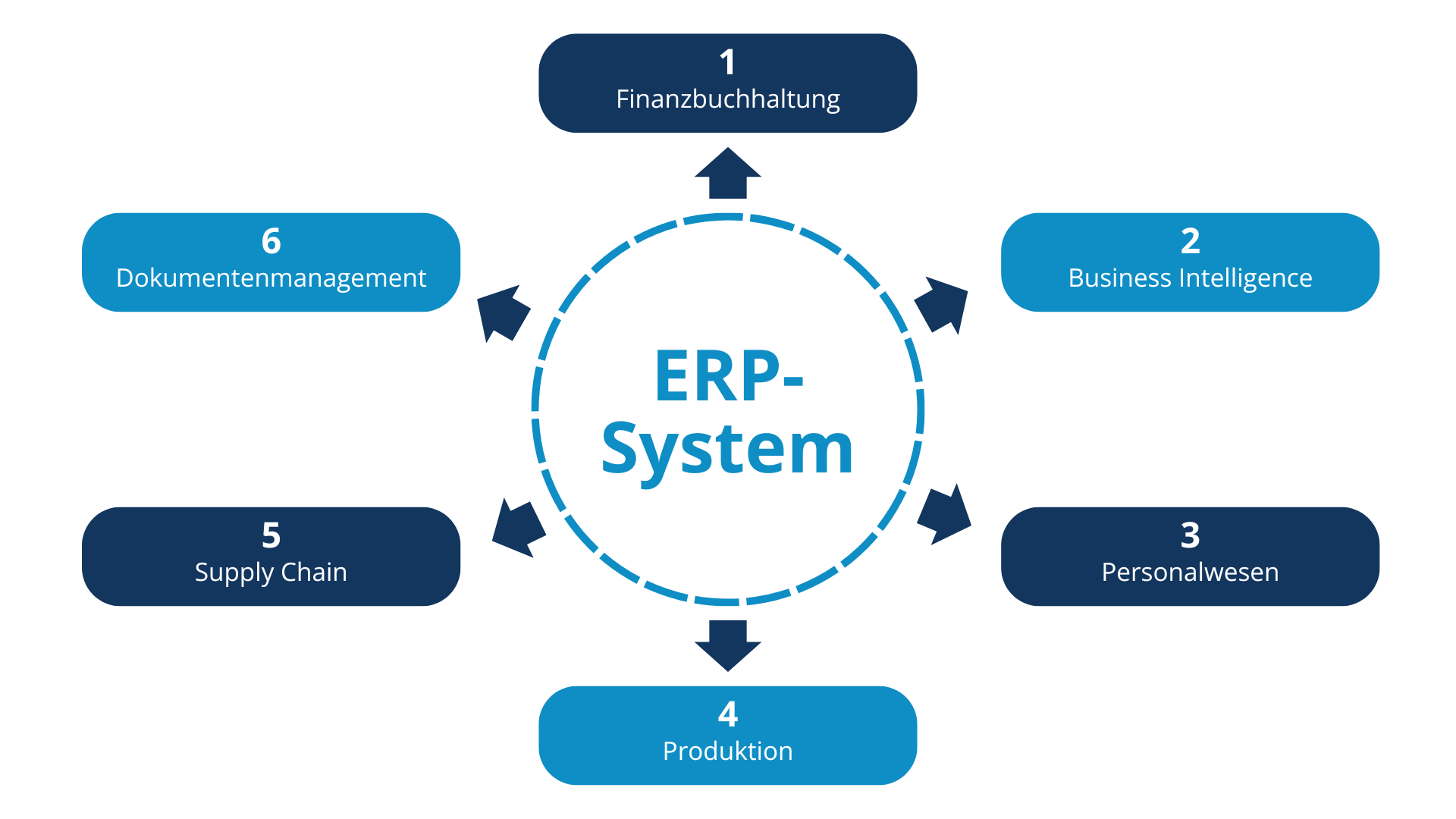
Financial Accounting
Business Intelligence
Human Resources
production
Supply Chain
Document management.
It quickly becomes apparent that all of the aforementioned areas are more or less directly related to finance. And that’s precisely why ERP, as financial accounting software, enjoys such immense popularity. ERP software, specifically the accounting module, operates on various levels and offers a solution that can be seamlessly integrated into existing financial accounting systems.
What functions does the accounting module offer?
Financial Accounting
After integrating your financial accounting into the ERP system, you can use all the functions relevant to accounts payable and accounts receivable. Post documents, manage master data, and track incoming payments. Modern accounting software of this kind naturally complies with all legal requirements.
Understand costs
When analyzing your company’s success, it’s crucial to track not only transactions but also costs. How convenient that an ERP system allows you to monitor payments to suppliers. Simply integrate your cost accounting into your ERP system and utilize its features. Easily determine how much money you spend in each area and maintain the corresponding documentation! This way, you keep a clear overview of all your expenses.
Asset accounting
A comprehensive financial management system includes monitoring a company’s fixed assets and conducting relevant analyses from time to time. Depreciation plays a particularly important role in this context. ERP software helps to consider all requirements and comply with legal regulations.
Keep an eye on material costs
Anyone wanting to fully leverage the advantages of modern inventory management should also use ERP systems to stay informed about current stock levels at all times. This data helps prevent the aforementioned bottlenecks and enables companies to respond to customer inquiries as quickly as possible. Searching for the relevant data and information should not take longer than necessary.
Planning and controlling
Almost every business owner knows that occasionally, a glimpse into the future would be helpful to meet all requirements. But even here, reliable ERP software comes to the rescue. The accounting data ensures that nothing should stand in the way of up-to-the-minute planning. It’s an excellent solution for anyone who wants to quickly and easily access their budget, profit and loss statement, and other details using modern systems.
What solutions can those who have outsourced their financial accounting use?
Many companies have outsourced their financial accounting over time. There’s no doubt this is a practical solution that initially makes using in-house accounting software unnecessary… or does it? Those who have outsourced their accounting to a tax advisor can also benefit from using accounting software or ERP software.
Invoices, customer information, and receipts are then easily transferred via an ERP interface. The advantage: This is often far less complicated than expected. Important accounting data, for example, regarding incoming and outgoing invoices, is then automatically forwarded to the respective accounting software and processed there.
Furthermore, integrating the ERP solution allows companies to access data related to inventory management and finance within moments. This enables many companies to save costs almost incidentally. A company that handles as many tasks as possible related to financial accounting and inventory management not only has constant access to important figures but also typically pays less for external tax advice.

Conclusion: This is why it's worthwhile to integrate ERP software into the daily operations of a company.
If you take a closer look at ERP systems, their requirements and advantages, you will surely quickly realize that integrating financial accounting into ERP systems makes sense for both small and large companies.
It is particularly convenient, of course, that an ERP system makes it possible to map all data relevant to financial accounting. Questions such as:
Which customers generate the most revenue for me?
Which items sell best? (Or: Which items are not worth selling?)
How much budget do I still have available?
Am I making optimal use of all my resources?
They can be optimally represented using an ERP system and the respective software or function.
Finally, integrating systems saves time. Companies that prefer to automate processes can sit back and focus on their core business once the ERP software is set up. And don’t worry! Integrating ERP software doesn’t mean you have to forgo working with an external tax advisor! Quite the opposite!
Numerous interfaces now exist, demonstrating how easy it is to exchange and analyze relevant data. Whether a company focuses on selling products or providing services, the various systems are virtually “universal” and applicable in every industry, and will therefore undoubtedly continue to play a vital role for many market players in the future.