Implementing an Enterprise Resource Planning (ERP) system is a major step for many companies toward increasing efficiency and optimizing processes, and it represents a crucial component of their IT landscape. An ERP system enables the integration and centralized management of all business processes. However, for the ERP system to reach its full potential, other IT systems within the company must also be able to interact seamlessly with it.
This is where ERP interfaces come into play. Here you will find everything you need to know about ERP interfaces and why their correct implementation and maintenance are crucial for the success of an ERP system.
What is an ERP system?
An ERP system is business software that helps companies automate and optimize their business processes. These ERP solutions integrate data and functions from various departments, such as finance, production, sales, purchasing, and human resources, into a central system. Through real-time data exchange, these software systems provide a comprehensive view of a company’s business processes, enabling well-informed decisions.
An ERP system typically offers the following core functions:
- Financial and accounting functions, such as invoicing, account reconciliation, budgeting and bookkeeping.
- Production and warehouse management functions, such as material requirements planning, inventory management and quality assurance.
- Sales and marketing functions, such as quotation and order management, customer management and sales analysis.
- Purchasing and supplier management functions, such as order and supplier management and order status monitoring.
- Human resource management functions, such as recruitment, employee administration, payroll and employee performance management.
What should good ERP systems be able to do?
Good ERP systems should meet various requirements to satisfy the needs of businesses. Some important characteristics that a good ERP system should have are:
- Integrated business processes: A good ERP system should integrate business processes from different departments, such as finance, production, sales, and purchasing. This allows the company to improve the efficiency and effectiveness of its business processes.
- Flexibility and adaptability: It should also be flexible and adaptable to the specific needs of the company. It should also be able to grow with the changing requirements of the company.
- Data storage and security: Furthermore, it should use a secure and reliable database to ensure data integrity and security.
- Analytical skills: The ideal candidate should also be able to analyze data and provide insights into the company’s business processes. This enables the company to make informed decisions and continuously improve its business processes.
- Ease of use: The system should be easy to operate and have an intuitive user interface. This allows employees to work with the system quickly and efficiently, access data, and complete their tasks.
- Scalability: Finally, a good ERP system should also be able to grow with the company’s growth and be scalable.

What are ERP interfaces?
ERP interfaces are interfaces that can be established between different ERP systems or between ERP systems and other applications. These interfaces enable data exchange between different systems to ensure that the data is available in real time, accurate, and consistent.
This simplifies communication between different systems and departments. It can also help reduce manual effort in data transfer and processing, and improve the efficiency of business processes.
There are various types of ERP interfaces, such as file interfaces, web services, and direct database connections. Choosing the right interface depends on the company’s requirements and the technical capabilities of the solution involved.
Improve your business efficiency
Reduction of manual input
ERP interfaces can automatically synchronize data between different systems, reducing the need for manual input.
Improved accuracy
Automatic data synchronization can also improve data accuracy and consistency by minimizing the likelihood of human error.
Better decisions
They allow different departments to access the same real-time data, which facilitates informed decisions based on up-to-date information.
Accelerated processes
The integration of data and systems leads to faster processes, as the required information is available more quickly.
Improved customer relationships
ERP interfaces enable companies to process customer inquiries and orders more quickly, which increases customer satisfaction and contributes to better customer relationships.
How do you choose the right ERP interface for your company?
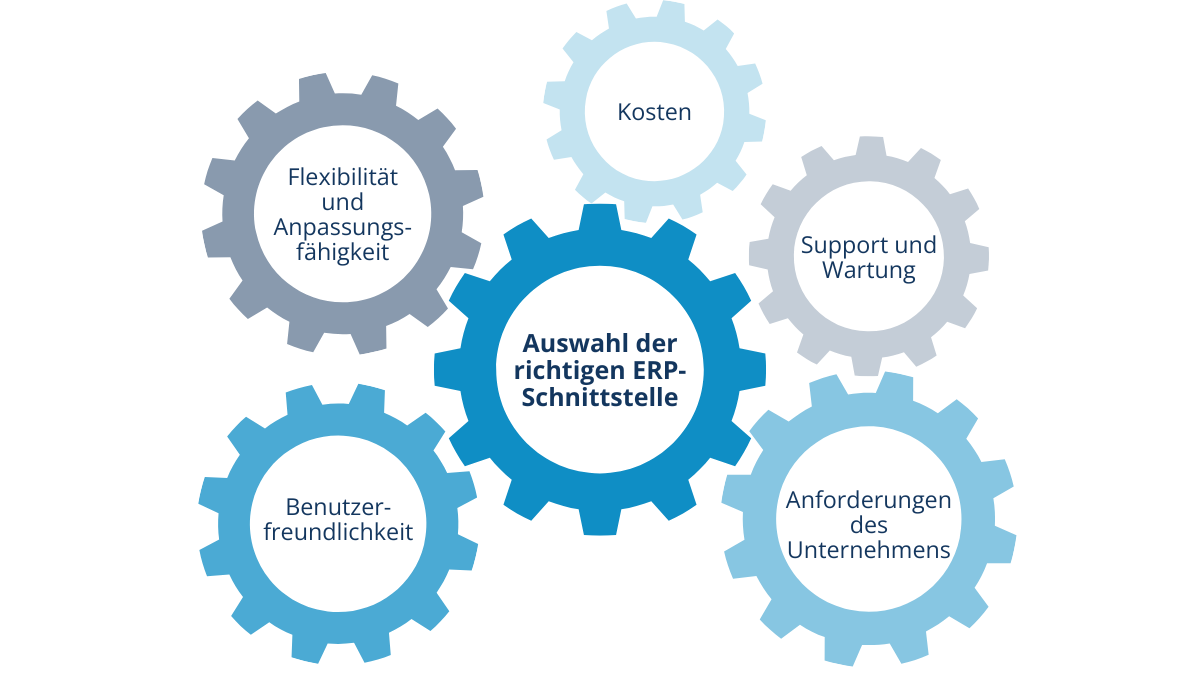
ERP software is indispensable today for managing business processes and organizing company resources. One of the most important decisions when implementing an ERP system is choosing the right interface.
Company requirements
Before choosing an ERP interface, you must carefully analyze your company’s specific requirements. Consider which functions the interface should offer and what data it needs to process. Comprehensive analysis can help define the right requirements to find an ERP interface that meets your company’s needs.
Ease of use
Ease of use also plays a role in selecting the right ERP interface. The interface should be easy to use and offer users a pleasant and intuitive experience.
Flexibility and adaptability
Another important factor when choosing an ERP interface is its flexibility and adaptability. It should be able to adapt to the company’s needs and integrate with other systems.
Support and maintenance
Furthermore, support and maintenance should be considered when selecting the appropriate ERP interface. The interface should be provided by a reliable vendor who offers good support and regular maintenance and upgrade services.
Costs
Last but not least, the price of the ERP interface is an important factor in the decision. The costs for implementing and maintaining an ERP interface can vary depending on the provider and the specific requirements of the company.
One should be aware that choosing a cheap solution may not be the best decision, as it may not meet the company’s needs and could potentially lead to higher costs in the future.
What types of interfaces are there?

There are basically two ways to set up interfaces between ERP and external systems. Ideally, existing interfaces provided by the ERP system can be used. However, these are often only configured for specific external systems from partner companies with whom the ERP provider regularly collaborates. Integrating such systems usually proceeds smoothly. But not all companies use precisely these products.
Therefore, many companies often have no other option than to have new interfaces developed for specific software solutions. However, this takes time and can be expensive. An interface always connects two different software systems. Therefore, you will need to collaborate with both the ERP solution provider and the provider of the external system for your interface.
Standard interfaces
Standard interfaces are pre-built modules provided by most ERP systems. These interfaces are typically designed for integration with other common applications such as CRM systems, WMS systems, and e-commerce systems. Standard interfaces are generally easy to implement and require minimal customization.
Individual interfaces
Custom interfaces are developed specifically for the requirements of a particular company. This type of interface allows a company to seamlessly integrate data and processes from other applications into its ERP system. However, custom interfaces require more development effort and are generally more expensive than standard interfaces.
Middleware solutions
Middleware solutions are software tools that act as intermediaries between a company’s various applications, facilitating data exchange. These solutions can help reduce integration complexity and shorten implementation time. Middleware solutions can also improve data quality and consistency and enhance integration security.
Which applications can I integrate into ERP systems?
CRM system
ERP and CRM systems enable better data exchange between the two systems, which can lead to improved customer satisfaction and higher sales.
E-commerce platforms
Integrating ERP systems with e-commerce platforms can automate the ordering process and simplify inventory management.
Production systems
The integration of ERP systems with production systems enables better planning and control of production processes and can improve productivity and efficiency.
Accounting software
Accounting software can automate accounting processes and improve the accuracy of accounting.
Human resources management software
Integrating human resource management software can automate the management of personnel information and data and simplify the HR process.
Updates and maintenance cycles
Updates and maintenance cycles are necessary to fix vulnerabilities and bugs in the software and to ensure compatibility with other applications. If companies neglect these updates and maintenance cycles, the interfaces will no longer function properly and data transmission problems may occur.
To avoid this, companies should ensure their ERP systems are up to date and that all necessary updates and patches are installed regularly. This should be done in close cooperation with the ERP provider to ensure that the interfaces are updated correctly and no compatibility issues arise.
Another important aspect is the regular maintenance of the interfaces. This includes monitoring system logs to identify errors or unusual activity, as well as conducting regular tests to ensure that the interfaces are functioning correctly.
It is also important for companies to have a backup system so they can quickly revert to a previous version in case of problems. The backup system should be tested regularly to ensure it functions reliably in an emergency.
ERP interface frameworks
An ERP interface framework is a set of tools, libraries, and components that enable the integration of applications into an ERP system. Numerous frameworks are available on the market, each suited to different requirements and business applications. These frameworks offer a wide range of tools and functionalities for integrating applications and systems, including ERP systems.
It enables the exchange of data in real time, the automation of business processes, and offers flexible connectivity options for various applications.
These frameworks also offer a variety of features to facilitate the integration of applications into an ERP system, including real-time integration, API management, data conversion and cleansing, and a user-friendly interface for configuring integration workflows.
However, it’s important to note that selecting the right ERP interface framework depends on various factors, such as the complexity of the ERP system, the size of the company, the required functionalities, and the budget. A thorough analysis of business requirements and a comprehensive evaluation of the available options are crucial for finding the most suitable framework for integrating interfaces into the ERP system.
In conclusion, ERP interface frameworks offer a valuable resource for businesses to integrate applications and systems into an ERP system and automate business processes. However, selecting the right framework requires careful consideration and evaluation of the available options. Therefore, companies should work closely with experienced ERP experts and vendors to achieve the best possible interface integration within their ERP system.
Cloud technology
Cloud technology has become a central element in the world of Enterprise Resource Planning (ERP) systems. Its popularity has increased significantly in recent years, especially during the pandemic.
Many companies had to quickly switch to digital solutions, and the cloud offered a flexible, rapidly implementable option. This development has led to a permanent shift towards cloud-based ERP systems. Cloud technology offers not only flexibility but also scalability and efficiency in data processing, making it a preferred choice for companies seeking future-proof and agile ERP solutions.
Internet of Things (IoT)
The Internet of Things (IoT) has established itself as an influential trend in the ERP landscape. It involves the integration of computer technology into various machines and devices, which is particularly important for manufacturing companies. IoT enables the digital networking of production machines, leading to a significant increase in efficiency and automation in production processes.
IoT is expected to continue gaining importance in many industries, with forecasts predicting significant revenue growth in the coming years.
Artificial Intelligence (AI)
Artificial intelligence (AI) has become an indispensable component of modern ERP systems. AI technologies offer advanced possibilities for data analysis, pattern recognition, and improving customer service through automation. For example, AI-powered chatbots can make customer interactions more efficient and thus contribute to improved customer satisfaction.
In a world characterized by vast amounts of data and high customer expectations, AI plays a crucial role in increasing the efficiency and effectiveness of business processes. AI technologies enable companies to extract meaningful insights from their data and make informed decisions.
The need for ERP security
ERP systems are an attractive target for cyber attackers due to the large amount of sensitive data they store and process. These systems unify different business areas and enable centralized data management, making them a critical point in a company’s IT infrastructure.
A security breach in an ERP system can lead to access to critical business data and thus cause enormous damage. Therefore, a robust security concept for ERP systems is essential to ensure data integrity and confidentiality while simultaneously safeguarding the company’s continuous operation.
Vulnerabilities and threats
The complexity and large number of users of an ERP system increase the risk of security breaches. Companies often overlook the need to invest in appropriate cybersecurity measures, leaving their systems vulnerable to attacks.
Many ERP systems are also outdated, meaning they haven’t been patched or updated for years. These vulnerabilities make it easy for attackers to penetrate the systems and cause significant damage.
Challenges
Securing ERP systems presents numerous challenges. These include the complexity of the systems, a lack of expertise, insufficient system updates, and problems with assigning permissions.
Many companies do not use multi-factor authentication methods, which further weakens security. The shortage of trained specialists in ERP security exacerbates the problem, as ERP security solutions are often not integrated into a central cybersecurity monitoring system.
Best-Practices
To ensure the security of ERP systems, it is crucial to establish effective control measures. This includes the implementation of ERP security solutions, the integration of these solutions into the company’s overall security management, and regular employee training.
Furthermore, it is important to regularly update all systems and software and implement strong password policies. To protect themselves against external risks, companies should also rely on specialized security solutions for ERP systems that can detect and prevent misuse and unauthorized access.
Conclusion
In summary, ERP interfaces are a crucial component of an effective enterprise resource planning (ERP) system. They enable the exchange of data between different applications and contribute to the automation and optimization of business processes. However, integrating interfaces into an ERP system can be complex and typically requires specialized expertise.
ERP interface frameworks offer companies a valuable resource for integrating applications and systems into an ERP system and automating business processes. A wide variety of frameworks are available on the market, each suited to different requirements and business applications. However, selecting the right framework requires careful consideration and evaluation of the available options.
Overall, it is important that companies proceed carefully when integrating ERP interfaces and work closely with experienced ERP experts and vendors to achieve the best possible integration of interfaces into their ERP system. Successful interface integration allows companies to optimize their business processes and improve their competitiveness.