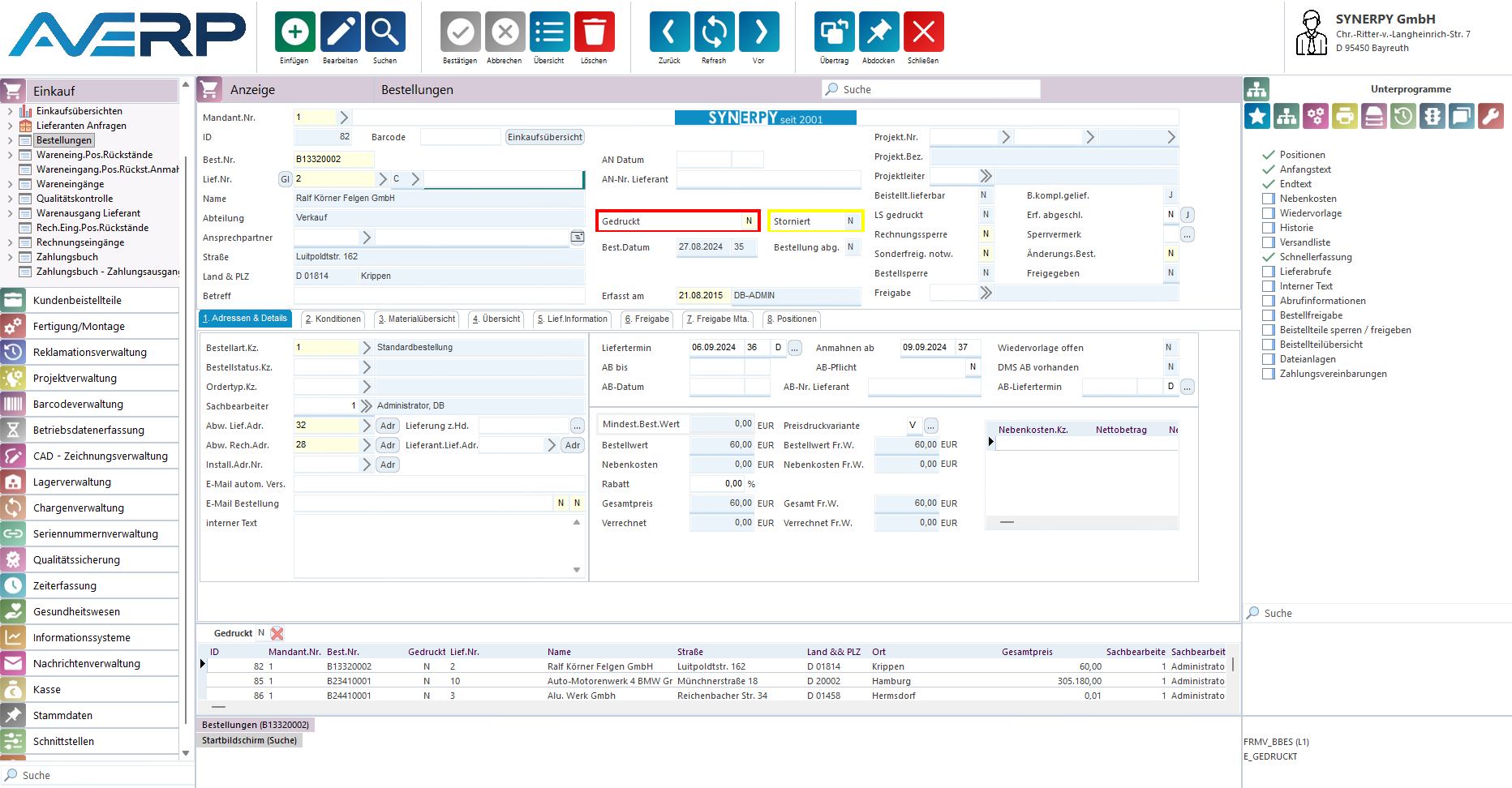
In today’s competitive business environment, it is crucial to implement effective systems to optimize business processes and better utilize company resources. AvERP enables you to effectively support your company’s trading and business operations.

In today’s competitive business environment, it is crucial to implement effective systems to optimize business processes and better utilize company resources. AvERP enables you to effectively support your company’s trading and business operations.
In addition to AvERP’s standard modules for sales (including CRM), purchasing, manufacturing and assembly, warehouse management, production planning, employee management and time tracking, and complaints, we offer optimized processes for specialist retailers, including the following modules (also available completely free of charge):
An ERP (Enterprise Resource Planning) system, such as our AvERP ERP software, is a type of software that helps companies optimize, automate, and integrate their business processes and operations. This includes, for example, financial accounting, inventory management, production planning and control,
Modern ERP systems are generally superior to older systems because they offer a wide range of features and capabilities that older systems lack. Furthermore, by utilizing new technologies like artificial intelligence, modern systems are typically more flexible and adaptable than their predecessors.
AvERP can be adapted to the changing requirements of the company without causing major problems or costs.
A trading company is a business that sells goods and services to customers who are not directly involved in the production of the products sold or the provision of the services. Thus, trading companies typically purchase products from manufacturers, wholesalers, or other suppliers and resell them to end customers or other businesses. This means that a trading company generally does not manufacture products itself but focuses on the sale and distribution of products.
There are different types of trading companies that specialize in different industries and distribution channels:
Retailers sell products directly to end customers in their stores, online shops, or other sales channels. Examples of retailers include supermarkets, clothing stores, electronics stores, and furniture stores.
Wholesalers buy products in bulk from manufacturers or other suppliers and resell them to retailers or other businesses. They often specialize in particular industries or product categories.
Distributors buy products from manufacturers and supply them to retailers or other businesses. They often specialize in specific geographic areas or industries.
Online retailers sell products via the internet to end customers or other businesses. These can be either independent companies or part of a larger retail company.
An ERP (Enterprise Resource Planning) system can perform a variety of tasks in retail, including:
Manage customer orders and automatically send orders to suppliers.
Monitor inventory levels and stock movements and automatically place orders for missing products.
Automate financial processes such as invoicing, accounting, and tax returns.
Centrally manage customer data such as order histories and contact details, as well as supplier information.
Automate sales processes such as offer and order management, as well as customer relationship management.
Provide real-time data on inventory, orders, and sales to identify trends and areas for improvement.
Automate HR processes such as payroll, personnel administration and vacation planning.
Integrate and automate online shop platforms and marketplaces.
Provide analyses and forecasts to support strategic decisions and actions.
Ensure integration with other systems such as merchandise management systems or CRM systems.
This list is not exhaustive and additional functions and tasks may be added depending on the company and industry.
CRM stands for Customer Relationship Management and is a system for managing customer relationships. It encompasses the strategies, processes, and technologies that companies use to capture, analyze, and utilize customer interactions and data to improve customer relationships and generate business opportunities.
A CRM system is an essential component of ERP software in the retail sector, as it helps businesses better understand their customers and take their needs and preferences into account. With an integrated CRM solution, companies can centrally manage and analyze all interactions with customers and potential customers. This enables a rapid response to customer inquiries with personalized offers and recommendations. Furthermore, CRM systems can also provide a central platform for managing marketing and sales activities, such as campaign management and lead generation. This allows companies to develop targeted marketing and sales strategies and address customers specifically based on their interactions with the company.
Omnichannel is a sales model in which customers are served consistently and seamlessly across various sales channels. This means that customers are able to purchase products through different channels such as online shops, brick-and-mortar stores, mobile apps, or social media platforms and experience a unified brand experience.
Therefore, it is an important component of ERP systems in the retail sector, as it enables companies to serve customers across all channels while ensuring a consistent customer experience. Omnichannel allows companies to increase their reach and presence across various channels and engage customers at the touchpoints where they feel most comfortable.
An integrated ERP system can help synchronize data and inventory across all channels in real time, ensuring that customers have access to the same information and offers on every platform. This allows companies to increase customer satisfaction and boost sales.
Another important aspect of omnichannel is the ability to conduct customer analytics. With an ERP system, companies can centrally manage and analyze customer interactions and data. This allows them to gain insights into which channels and interactions are most effective for retaining and converting customers.
Warehouse management, or inventory control, refers to the management of stock levels, the storage of goods, and the processes related to the receipt and dispatch of goods in a warehouse or distribution center. Warehouse management helps companies manage inventory in real time, reduce costs, and improve the efficiency of warehouse processes. A well-designed warehouse management system helps ensure that goods are moved quickly and effectively from one warehouse to another and maintains high accuracy in inventory management. Furthermore, such a module can help synchronize warehouse management with other business processes within the company, such as procurement, sales, and manufacturing. By integrating these processes, companies can improve
While ERP systems undoubtedly offer many advantages, we must not overlook the associated challenges regarding data security and compliance. Data security is of paramount importance in today’s digital world. For businesses in the retail sector that use ERP systems, it is crucial to ensure that their
To ensure data security in an ERP system, companies should implement several best security practices. These include:
Access control ensures that only authorized employees can access specific data. This can be achieved by assigning permissions and roles within the ERP system.
All sensitive data stored or transmitted within an ERP system should be encrypted. This protects the data from theft or interception during transmission.
Companies should conduct regular security audits to identify and address vulnerabilities. This can help detect and close security gaps early.
Employees should receive security awareness training to prevent phishing attacks and other social engineering tactics. Human error is often the primary cause of security breaches.
ERP providers regularly release updates and patches to fix security vulnerabilities. Companies should ensure that they keep their ERP systems up to date.
A well-thought-out emergency recovery plan is essential to be able to react quickly and minimize damage in the event of a security incident.
Adherence to these security practices is not only important to protect data from cyberattacks, but also to comply with legal requirements.
The retail sector is subject to a multitude of regulations and compliance requirements, which can vary depending on the region and industry. These regulations aim to ensure consumer protection, the integrity of financial data, and fair competition. In the context of ERP systems, companies must ensure that their systems meet applicable compliance requirements. Here are some key compliance areas in the retail sector:
The General Data Protection Regulation (GDPR) in the European Union and similar laws worldwide require companies to ensure that personal data is adequately protected. This applies particularly to the retail sector, as it often collects extensive amounts of customer data.
Companies in the retail sector must prepare and submit accurate and transparent financial reports. This is necessary to gain and maintain the trust of investors and the public.
Tax laws vary from country to country and can be complex in business. Companies must ensure that their ERP systems are capable of correctly processing the necessary tax information and generating reports for tax purposes.
In the retail sector, products often have to meet specific safety standards. This applies particularly to industries such as food and electronics. ERP systems can be used to track the product lifecycle and ensure compliance with these standards.
The retail sector often requires complex warehousing and logistics processes. Companies must ensure that their ERP systems comply with applicable regulations and best practices regarding storage, transportation, and delivery.
Failure to comply with these requirements can have serious legal and financial consequences, including fines and legal liability. Therefore, it is essential that companies ensure their ERP systems are configured to meet these requirements.