Industry

Industry

In an increasingly globalized and competitive business world, companies in the industrial sector are looking for effective solutions to optimize their operational processes in the areas of logistics and IT and to increase their competitiveness. This is where a high-performance Enterprise Resource Planning (ERP) system comes into play.

Here, we will examine in detail the role of ERP systems in industry and how they help companies maximize operational efficiency, reduce costs, and improve the quality of their products and services. We will consider both the general benefits of ERP in industry and specific application areas and functions that are crucial for this multifaceted environment.

As an experienced provider in the ERP industry, we are aware of the challenges faced by industrial companies. Therefore, we want to offer you valuable insights and practical information to help you choose ERP software that is specifically tailored to the needs of your industry.

Learn more about the advantages of centralized data management, the integration of different business areas, process automation, and the analysis of real-time data for informed decision-making. Discover how ERP systems are specifically tailored to the needs of the industrial sector and can offer solutions for industry-specific challenges.

AvERP in industry

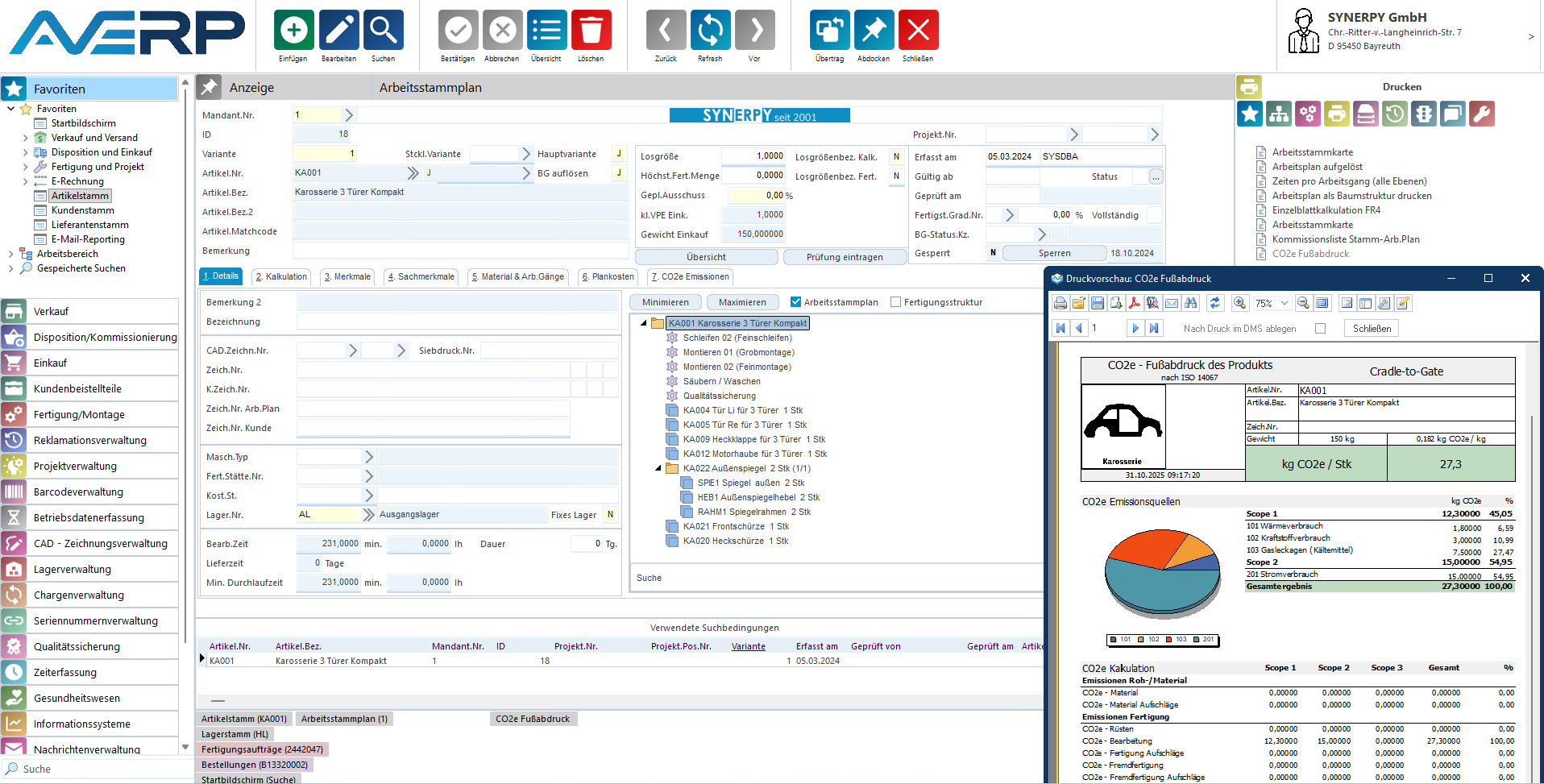
With our ERP solution AvERP, you’re always one step ahead. In today’s competitive industrial world, a powerful ERP system is the key to optimized business processes, increased efficiency, and a clear competitive advantage. With the right ERP modules, industrial companies can improve their production planning and control, optimize their warehouse management, strengthen quality assurance, streamline materials management, and perform accurate pre- and post-calculation. In addition to AvERP‘s standard modules, we offer industry-optimized processes, including the following modules (also available completely free of charge):

  • Series, variant, and single-part or small-series production
  • Alternative position in parts lists
  • Serial number history and device file (purchasing and sales side)
  • Offer configurator with generation of sales bills of materials and configuration dependencies
  • Offer versioning
  • Tracking of externally manufactured parts/extended workbench
  • Serial number-specific complaint management
  • Management of wear parts

The Industrial Revolutions

These four industrial revolutions fundamentally changed the way businesses produce, communicate, and interact, marking a significant development in industrial history. Each revolution brought forth new technologies and innovations that transformed industry and society.

Industry 4.0 – the future of manufacturing with ERP systems

In today’s industrial landscape, the fourth industrial revolution, also known as Industry 4.0, has taken on a significant role. This revolution is characterized by the integration of advanced technologies into industrial manufacturing, enabling companies to build smart factories and optimize their production processes. A key component for the success of Industry 4.0 is a high-performance enterprise resource planning (ERP) system.

ERP systems play a crucial role in implementing Industry 4.0 concepts by enabling seamless integration and communication between different systems, machines, and equipment. By capturing and processing real-time data from across the entire production line, ERP provides companies with comprehensive visibility and control over their processes.

Automation

Another key aspect of Industry 4.0, supported by ERP, is automation. By connecting ERP systems with smart machines and IoT devices, companies can automate and optimize their production processes. This not only minimizes human error but also increases efficiency and productivity.

Analysis and maintenance

Furthermore, ERP in Industry 4.0 offers the possibility of predictive analysis and maintenance. By integrating ERP with advanced analytics tools, companies can identify patterns and trends to predict future bottlenecks or maintenance needs. This enables preventive maintenance to minimize unplanned downtime and maximize plant uptime.

communication

The advantages of ERP for Industry 4.0 are manifold. An effective ERP solution enables seamless communication between the various stakeholders in the production line, including suppliers, production, warehousing, and sales. It provides real-time data for informed decision-making, optimizes resource allocation, and improves quality and customer satisfaction.

AvERP as a solution

Als Anbieter von ERP-Lösungen verstehen wir die Bedeutung von Industrie 4.0 für die heutige Industrie. Unser ERP-System AvERP ist speziell darauf ausgerichtet, Unternehmen bei der Umsetzung dieser revolutionären Konzepte zu unterstützen. Von der Integration mit IoT-Geräten bis zur Datenanalyse bieten wir Ihnen die Werkzeuge, die Sie benötigen, um Ihre Fertigungsprozesse zu optimieren und die Vorteile von Industrie 4.0 voll auszuschöpfen.

Invest in the future of your manufacturing and discover how a robust ERP system can help you meet the challenges of Industry 4.0. Learn more about the possibilities ERP offers and see the benefits for your business. Contact us today to find out more!

The license-free ERP system for small and medium-sized enterprises.

Networking your departments

In an increasingly globalized and digitalized world, where seamless collaboration and effective communication are key to success, an ERP system plays a crucial role. An ERP system not only serves as a data hub but also as a catalyst for optimizing business processes.

An ERP system enables impressive integration and effortless information flow between the various departments and functions of a company.

Imagine your employees across different departments being able to access the same real-time data and effortlessly share information. Instead of relying on manual reports or countless emails, they have instant access to the latest information. The result? Communication that is more effective and efficient than ever before.

When sales, production, procurement, and finance departments can access the same data, more informed decisions can be made. This also accelerates responsiveness to market dynamics and customer needs.

But an ERP system can do even more: It enables seamless collaboration and coordination between different departments. Finally, coordinated tasks are completed without the hassle of manual handoffs or duplicate data entry. This fosters collaboration and reduces errors and misunderstandings that could arise from faulty or delayed communication. Automating your business processes thus saves you not only time but also money, while simultaneously increasing your company’s efficiency.

Furthermore, an ERP system lays the foundation for improved customer service. Customer data, order histories, and support requests are easily accessible to every employee, enabling personalized and efficient customer support.

With an ERP system, companies can create custom dashboards and reports that display relevant information for each department.

These customized views allow employees to see the data that is most important to them. This enables them to share targeted information and make better decisions to optimize business processes.

Harness the power of connectivity – with a first-class ERP system that takes your communication and logistics to a new level. Discover the countless possibilities and revolutionize your business for a successful future.

The best modules for your ERP system in industry

A robust ERP system is key to the success of an industrial company. It offers the ability to seamlessly integrate all business processes, manage data centrally, and ensure efficient resource planning. To meet the specific requirements of the industrial sector, certain modules within an ERP software are essential.

Here are some of the most important ERP modules that can help you optimize your business processes:

Production planning and control (PPS)

This module enables the effective planning and control of manufacturing processes. It offers functions such as capacity planning, work order management, material requirements planning, and machine scheduling. With a robust production planning and control (PPS) module, you can optimize production processes, maximize resource utilization, and reduce delivery times.

Efficient inventory management is crucial for industry. A warehouse management (WM) module enables precise inventory tracking, optimized storage space utilization, and support for inventory reduction. Furthermore, it offers batch tracking capabilities, which are particularly important in industrial sectors, food processing, and pharmaceuticals to ensure product traceability at all times. In short: Effective warehouse management allows you to avoid bottlenecks, optimize and monitor the supply chain, and improve customer service.

In the industrial sector, high product quality is of paramount importance. A quality management (QM) module supports you in defining and monitoring quality standards, conducting inspections, ensuring product traceability, and managing complaints. With a robust QM module, you can continuously improve quality and meet customer requirements.

Furthermore, a QM module can also manage employee training documentation, ensuring that staff possess the necessary qualifications and training to meet quality standards at all times. Simultaneously, the creation of test plans and the execution of internal and external audits are managed by the quality management module.

Efficient management of materials and procurement processes is crucial for industry. A materials management module enables optimized procurement planning, supplier management, order processing, and invoice control. With this module, you can improve material flow, reduce costs, and avoid material supply bottlenecks.

In industry, it is crucial to have an accurate and up-to-date overview of the components and materials required to manufacture a product.

ERP bill of materials management offers functions such as defining product structures, linking (alternative) materials, assemblies, and operations, as well as tracking changes and revisions. This allows the company to react flexibly to changes in product configuration.

With robust bill of materials management, companies can ensure efficient production planning and control, optimize material availability, and guarantee product quality.

An SCM module offers comprehensive visibility and control across the entire supply chain. It includes features such as inventory tracking, demand forecasting, and transportation management. In this way, the SCM module can contribute to optimizing transportation routes and reducing transportation costs.

In addition to the functions already mentioned, an SCM module also supports supplier management to evaluate the transport, performance and quality of suppliers.

An efficient human resources management module supports the administration of employees and applications. Monitoring and managing working hours, salary information, and vacation requests is simplified and automated, thereby accelerating HR processes and increasing employee satisfaction.

A robust finance and controlling module is essential for every company. It offers functions such as accounting, cost accounting, budgeting, financial analysis, and the generation of financial reports in accordance with international accounting standards.

This module automatically handles tax compliance and the management of VAT refunds. With this module, you keep your finances under control, can manage budgets effectively, and make informed decisions.

To achieve perfect cost transparency, calculate product or service costs, and above all, assess one’s own competitiveness, professional pre- and post-calculation is essential. This module enables companies to determine the costs of materials, labor, machinery, and other resources and compare them with the revenue generated.

Effective pre- and post-calculation enables companies to make informed decisions to maximize their profits, reduce costs, and improve their competitiveness.

This list of ERP modules is not exhaustive, as the specific requirements of each industrial company can vary. It is important to choose a flexible ERP system that allows you to add further modules and customize your solution accordingly.

As a leading provider of ERP solutions for industry, our AvERP ERP software offers a wide range of modules specifically tailored to the needs of the industrial sector. Contact us to learn more about our customized solutions and the best ERP modules for your business.
AvERP. Tailor-made, yet standard.

The license-free ERP system for small and medium-sized enterprises.