Industry

Injection molding / plastic

The manufacturing industry is one of the world’s most important sectors, and the use of Enterprise Resource Planning (ERP) systems has proven to be a crucial factor in the success of companies within this industry. Injection molding is a widely used manufacturing technology in this sector, employed across numerous industries. From the automotive industry to electronics manufacturing, injection molding enables the production of high-precision components in large quantities. However, to produce efficiently and economically, reliable and flexible planning and control of manufacturing processes is essential. Our ERP system, AvERP, plays a central role in this.

AvERP for injection molding

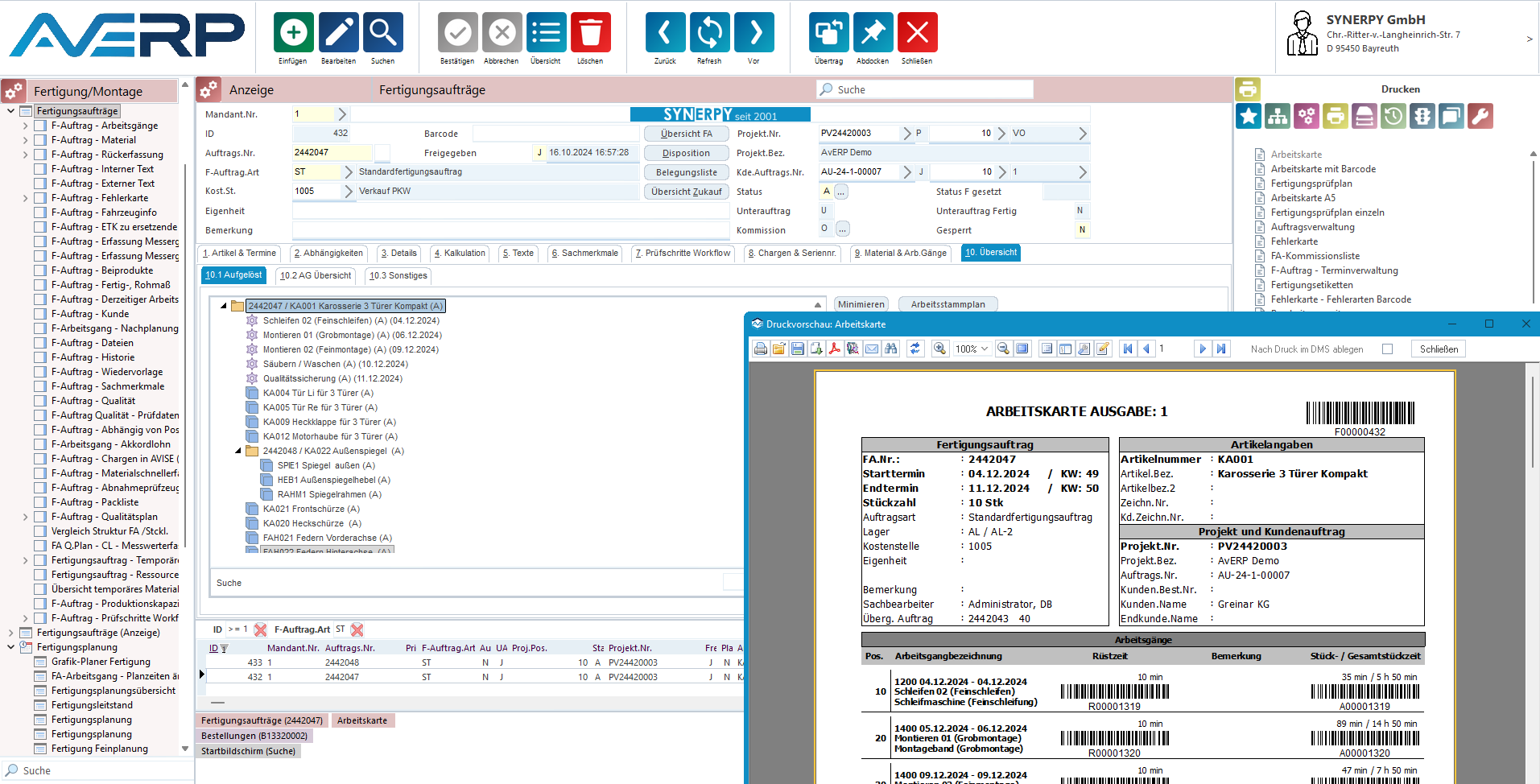
ERP systems play a crucial role in optimizing production processes in injection molding. AvERP, for example, enables effective production planning and control, precise inventory management, real-time monitoring, and seamless product traceability. Furthermore, AvERP supports compliance with cleanroom standards, thus contributing to the production of high-quality and safe products.

In addition to the standard modules of AvERP, the system offers processes optimized for injection molding, including the following modules:

  • Extensive material recording including sprue and gate.
  • Tool management with history, usage and maintenance plans, hierarchical structuring (tool usage), grouping into tool pools.
  • planning board
  • Measurement data acquisition (including cpk)
  • Comprehensive quality management (CAQ)
  • Test and measurement equipment management
  • 8D reports
  • Alloy surcharges

What is the injection molding process?

Injection molding is a widely used method for manufacturing plastic parts and components. It is an effective method for producing complex shapes and structures with high precision and repeatability.

The process begins with melting plastic granules in an injection molding machine. The molten plastic is then injected into a mold that has the desired shape of the part. The mold consists of two halves that are joined together during the injection molding process. One half of the mold remains stationary, while the other half opens and closes to remove the finished part. The injection molding machine The molten plastic granules are forced into the mold under high pressure. Once the mold is filled, the pressure is maintained to ensure the plastic is evenly pressed into the mold. After a short cooling period, the mold is opened and the finished part is removed. The injection molding process allows for high precision and repeatability. in the production of plastic parts. The molds can be designed to contain complex structures and details, and the injection molding process ensures that each part is produced uniformly and precisely.

The license-free ERP system for small and medium-sized enterprises.

What advantages does an ERP system offer in the injection molding process?

An ERP system offers numerous advantages in the injection molding process. From administration and tracking to disposal logistics and quality assurance, almost all important areas can be covered with AvERP.

Inventory management

Inventory management enables effective planning and management of material requirements. In injection molding, plastics are melted and shaped in a mold using high pressure and temperature. This requires precise control of the materials needed for the process.

Effective inventory management helps plan and manage material requirements to ensure sufficient material is available to maintain production. At the same time, it helps avoid excess inventory, which can lead to unnecessary costs. Accurate tracking of material movements also makes it possible to identify bottlenecks and delays and to plan production more effectively.

Effective warehouse management is also a crucial aspect of inventory management for ERP systems in the injection molding process. It helps to manage inventory effectively, including monitoring stock levels and tracking incoming and outgoing goods. This ensures that the material is always available when needed.

Finally, inventory management can also contribute to cost control. Accurate inventory tracking makes it possible to reduce material costs by avoiding overstocking and unnecessary orders. It can also help increase efficiency in injection molding by effectively managing materials to optimize production processes and prevent bottlenecks.

Real-time data transmission

Real-time data transmission is a crucial aspect of ERP systems in injection molding, as it enables precise and rapid production monitoring. In injection molding, various parameters such as pressure, temperature, and flow rate must be continuously monitored to ensure that the produced material possesses the required properties.

By transmitting data in real time, manufacturers can continuously monitor these parameters and adjust them as needed. This helps reduce errors and scrap, as problems can be quickly identified and resolved. Real-time data transmission can also contribute to a more stable and reliable production process, as changes can be implemented rapidly.

Furthermore, real-time data transmission enables precise tracking of inventory and material movements. This can help reduce material waste by accurately tracking materials and avoiding unnecessary orders.

Finally, it also enables better collaboration within the company, as all departments have access to up-to-date information. This allows decisions to be made faster, and problems to be identified and solved more quickly.

Batch tracking

Batch tracking is also crucial for ERP systems in injection molding, as it enables the precise identification of materials used in a specific production process. In injection molding, materials such as plastics are mixed in a specific ratio and injected into a mold to create a finished product. Batch tracking helps identify the exact composition of the materials and detect potential problems in the production process.

Batch tracking allows a company to trace a product’s entire lifecycle, from manufacturing to sale. This traceability is particularly important if a defective product is on the market or if there are safety issues. In such cases, batch tracking enables the company to quickly and accurately identify and recall all affected products.

Batch tracking can also contribute to improved quality management. Traceability allows companies to identify trends and patterns and pinpoint the root cause of quality problems. This enables them to optimize production processes and improve product quality.

Finally, it also enables compliance with laws and regulations. Specific standards and norms must be adhered to in injection molding processes, particularly in the food, medical, and automotive industries. Batch tracking allows companies to ensure that all materials meet the relevant standards and that all regulations are complied with.


Disposal logistics

Waste disposal logistics also plays a significant role for ERP systems in injection molding, as they can efficiently manage the disposal of waste materials and the reuse of products. Injection molding uses materials such as plastics, which often end up as waste and require environmentally friendly disposal.

ERP systems used in injection molding can automate and optimize waste management logistics by, for example, tracking the inventory of waste materials and monitoring which materials can be recycled. This allows companies to reduce their environmental impact while simultaneously saving costs.

Furthermore, waste management logistics can also contribute to promoting the recovery of raw materials and the reuse of products. In injection molding, products such as plastic pallets and containers can be recycled and reused. By managing these processes, an ERP system can ensure that these products are reintegrated into the production process, thereby improving the company’s sustainability.

Another important aspect of waste management logistics is compliance with environmental regulations and requirements. ERP systems can ensure that companies comply with all applicable environmental regulations and guarantee that waste materials are disposed of and recycled correctly.

Quality assurance

Quality assurance ensures that the manufactured parts meet requirements and standards. Injection molding is frequently used to produce parts for safety-critical applications where the quality and reliability of the parts are crucial. A defect in the production process can lead to dangerous situations and make the company liable.

ERP systems also improve quality assurance by automating processes and monitoring part quality in real time. For example, an ERP system can control the parameters of the injection molding process and automatically collect and store the data. By monitoring these parameters, deviations from standards can be detected and corrected before defective parts are produced.

Another important aspect of quality assurance is the tracking of batches and serial numbers. ERP systems can ensure that the manufactured parts can be uniquely identified and traced. This allows companies to quickly respond to quality issues and resolve production problems.

Furthermore, an ERP system in injection molding can improve quality assurance through the integration of quality management tools. Such a tool enables the evaluation and monitoring of part quality based on specific quality characteristics. This allows quality problems to be identified and resolved quickly.

AvERP. Tailor-made, yet standard.

The license-free ERP system for small and medium-sized enterprises.