
Whether a financial institution or a craft business: ERP software systems have always been considered the IT backbone of a company, integrating a comprehensive range of different business areas. A large majority of companies now work with this business software solution – but before getting started, there are several aspects you, as an employer, should consider.
In this article, we focus primarily on the financial aspects of an ERP solution. Many vendors and guides are vague when it comes to providing specific figures. Indeed, a standardized cost calculation for an ERP system is rarely possible. This is because the total costs depend on numerous factors, such as the number of users, training costs, customization and migration costs, maintenance, and the number of updates.
If you want to implement ERP software in your company, you need to consider various external and internal cost factors. You will learn more about these in the following article.
Internal costs

Generally speaking, before the decision is made as to whether or even which ERP solution will be implemented in your company, your company will already incur costs.
The reason for this is the lengthy selection process leading to a decision, which will already consume a significant amount of your staff’s time.
Furthermore, it is necessary to conduct a comprehensive process analysis to determine the specific ERP functions and modules required for your company.
External costs
The licenses for the ERP software and the adaptation of the system to the respective business processes represent the main external cost factor in most cases. Nevertheless, there are numerous other external factors that you should include in your cost planning, such as:
- required database licenses
- Hardware costs
- Consulting budget
Generally speaking, the costs of an ERP solution are individual and can vary significantly depending on the size and type of business. Nevertheless, we would like to give you an overview of the respective cost aspects you will encounter during the implementation and planning phase of your ERP system:
External costs arise for the ERP implementation and the continued use of the system, including:
- Licenses
- Consulting services from the providers
- customizing company services
- Employee training
- Maintenance and updates
- Adjustments
- Supports
Hardware and software
Software and hardware are generally considered the core components of an ERP implementation and therefore often represent the most expensive part. Choosing the right ERP system is therefore crucial and should be carefully considered beforehand.
Although further ongoing costs can be expected even after a successful ERP implementation, the ERP software usually accounts for the lion’s share of all costs.
The amount of these costs depends primarily on the following factors:
- Number of licenses required to use the ERP system
- Number of functions and modules that you define in advance in your requirements specification.
- Customizing effort – this refers to adapting a system to the individual needs of the company.
In general, it is true that every ERP software must be adapted to some extent to the specific requirements of a company so that the desired functions and tools can be used as effectively as possible.
Since the software solution is used for the entire company, it should have a high degree of flexibility to meet the diverse requirements of the different departments.
Therefore, the specifications document should be of central importance to you and should always be filled out by you as conscientiously as possible!
Nevertheless, it is true that even with a carefully maintained requirements specification, almost every ERP software must be adapted to some extent to the specific requirements of a company so that the desired functions and tools can be used as effectively as possible.
Costs for ERP employee training

After the successful implementation of an ERP solution, the next important step follows:
To introduce and explain the new software to your employees.
This not only incurs external training costs, but you also have to consider that your staff’s participation in training is equivalent to lost working time.
Keep in mind that training is not completed in a single day – sometimes a training phase can extend over several weeks or even months.
Typically, ERP training does not cover all employees of a company at the same time. Often, the system’s key users receive external training from the system providers and are then tasked with passing on their newly acquired knowledge within their departments, thereby training their remaining colleagues.
Maintenance work and updates
After the successful implementation of your ERP system, your biggest cost factor will be eliminated. However, you should bear in mind that even new software models require regular maintenance.
Typically, you agree on a maintenance contract with your software provider in advance, with fees calculated annually. Depending on the type of ERP system, regular updates may also be required in addition to maintenance, and these must be paid for separately if used.
In some cases, a so-called release change may occur—this may also require replacing parts of the ERP hardware. A release change can also lead to internal costs, as employees may need to be trained on the new changes, depending on the type of software.
The range of ERP solutions is vast – from 20 euros per month per user to six-figure sums, you will find everything on the market.
Factor in unplanned costs
Even if you have thoroughly researched flat-rate costs beforehand, unfavorable situations can arise years later that drive up the ongoing costs of your ERP solution. For example, a system reimplementation may be necessary after a major update, or other problems may occur that require you to engage external providers.
We therefore recommend: It’s worthwhile to look at other companies and exchange information with them about their experiences. The company might even agree to grant you access to their ERP system’s cost breakdown – this will give you an initial estimate of the costs you could expect.
Beyond the issue of costs, exchanging information with other companies is also helpful in sharing potential pitfalls and tips.
Furthermore, we recommend that you invest enough time in the planning phase to weigh up all possible risks in advance – this way you can avoid unpleasant surprises later.
Migration and adaptation costs
As a rule, migration and customization costs depend significantly on the number of users and the desired functionalities. Most ERP solutions are still considered to be based on classic on-premise licensing models.
This means that the company acquires a license for the basic model and must pay extra for additional models and tools relevant to the business. License prices are generally tiered according to the number of users working with the system.
In addition to the license fees, there are also the costs of data migration. Existing data from previously used systems must be transferred to the new ERP system and thus adapted to the business processes.
Therefore, the costs incurred for migration and adaptation are difficult to estimate without a prior analysis of the company.
Generally speaking, the more complex and extensive a company’s business processes are, the greater the effort required for data migration and the associated costs.
Release upgrades for ERP solutions are costly.

Traditional ERP solutions consist of so-called on-premise ERP basic software, which is supplemented by further desired modules and tools for the company.
As a rule, companies and their associated tasks and requirements are constantly evolving. This means that a major update or the implementation of new tools will become essential for you over time.
It’s important to note that the adaptation and migration phases of a release change require the most preparation and are therefore considered particularly costly. In addition to your own personnel costs, your company must also include the fees of external consultants in your cost estimates. Furthermore, in some cases, it may be necessary to conduct new employee training after a release, which also involves time and expense.
“ERP in Practice” - Study Results
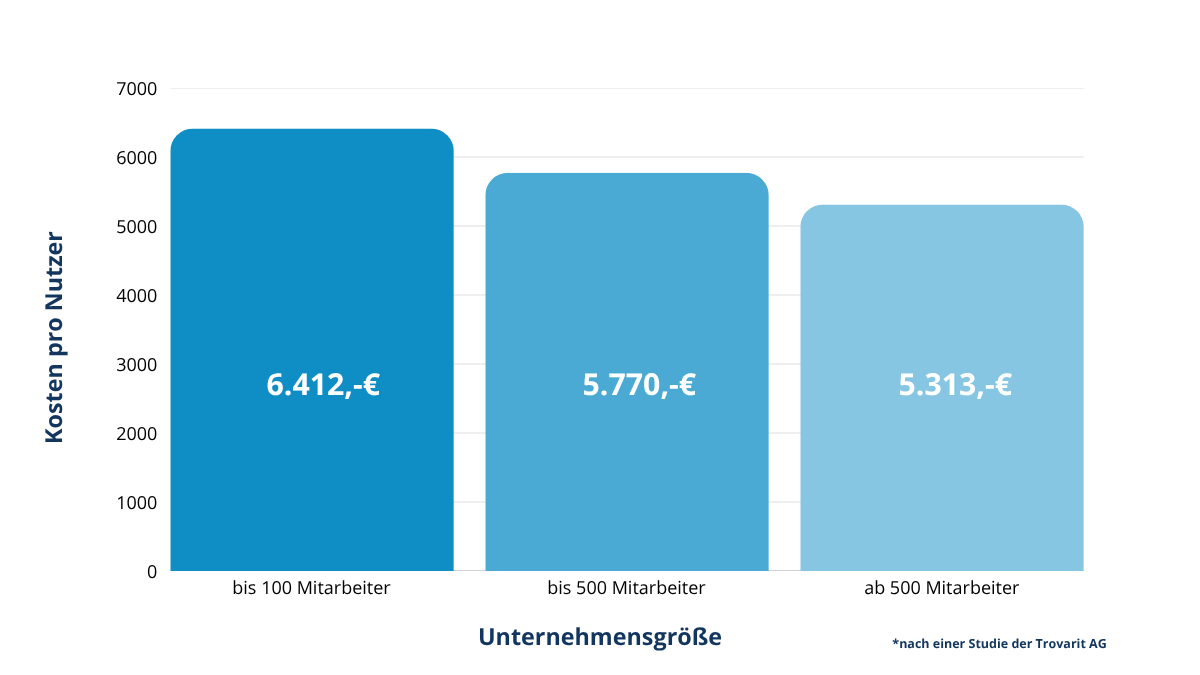
As previously mentioned, most articles on ERP system costs rarely provide concrete figures. In 2020, Trovarit AG conducted a study with over 15,000 participating companies in the DACH region (Germany, Austria, and Switzerland). These companies varied in size and industry.
The study found that the total cost of an ERP implementation is approximately 5,917 euros per workstation.
The study considered the costs for hardware, software licenses, and services. Interestingly, the larger the number of users in a company, the lower the cost per ERP user. The study found that total costs for small businesses with up to 100 employees are approximately €6,142 per user. For medium-sized businesses with up to 500 employees, the costs dropped to an average of €5,770 per workstation, and for companies with 500 or more employees, the cost per user license was approximately €5,313.
The analysis of budget and schedule overruns in ERP software projects is also interesting. The study revealed overruns in more than 50% of ERP projects. In the majority of these projects, the budget overrun ranged from 5% to 35%.
Free ERP systems
Some companies with in-house IT staff prefer to develop the necessary programming code and tools themselves when using a free, open-source ERP system. While it’s generally true that this approach can save a significant amount of money, it’s crucial that employers are always aware of the differences between free and paid ERP systems.
Fee-based ERP system vs. license-free ERP system
Consider the time factor
If you opt for an open-source ERP system, you are entirely responsible for software maintenance and implementation. Technical problems and challenges, in particular, can be very time-consuming for companies without support. And we all know: time is money.
Beware of hidden fees
Companies typically hope to save on the costs associated with ERP implementation and related expenses by using free, open-source ERP software.
However, beware: Depending on the type of open-source ERP, some companies charge a basic fee even for providing the open-source software.
Advantages of an open-source ERP solution
Despite all the concerns, there are also several advantages to open-source ERP systems compared to paid systems. Generally, free ERP software offers unlimited usage. Furthermore, an unlimited number of users can access the system without incurring additional costs – which can be a significant financial advantage, especially for companies with multiple benefits.
Generally speaking, it can be particularly useful for medium-sized companies to also take a look at free ERP software solutions before choosing an ERP system, such as our own open source system AvERP.
Do the costs of an ERP solution always increase with the number of users?
For many ERP solutions, such as SaaS or on-premise systems:
Typically, only a portion of users are active in an ERP system at any given time. Many providers take this into account by offering different licensing models, for example.
Named user model
The named user model is considered the classic ERP model by many companies. Here, the maximum number of users is defined in advance. Each authorized user is registered by name and logs in with their username and password before using the ERP solution.
Concurrent user model
In contrast, the concurrent user model has no limit on the number of computer installations. Here, only a maximum number of users who can access the ERP software simultaneously is defined in advance.
For example, a company might have 120 registered users, but only 80 users can work with the ERP solution simultaneously. Specifically, this means that if the 81st user wants to log in, they have to wait until another user logs out.
Employers who are fully informed about their company’s internal processes and can therefore accurately assess the system’s usage in advance can save on licensing costs with the Concurrent User Model.
Conclusion
External ERP licenses and the internal costs associated with implementing an ERP solution are often unaffordable, especially for small and medium-sized enterprises (SMEs). Therefore, so-called free open-source ERP systems can represent a viable alternative for interested parties.
However, this also presents various challenges and risks that must be carefully considered beforehand.
However, in general: Demand transparency from ERP providers!
Even though unforeseen situations can always arise, with sufficient transparency and prepared cost tables you can already factor in a large part of the costs in advance in your budget planning!