
However, the pressure on ERP systems to succeed is correspondingly high: The ERP solution, as a central component of the company’s IT infrastructure, is often intended to specifically ensure the company’s competitiveness in the future.
While most companies are familiar with the various ERP functions and their benefits, many employers are at a loss when it comes to the actual implementation of the system. This can have disastrous consequences—ERP implementation, in particular, presents a multitude of obstacles that can lead to its failure.
If you are currently facing the implementation of an ERP system, you will undoubtedly have many questions. This article provides an overview of how an ERP implementation works in practice, outlining the
The following article will help you to implement your ERP system as efficiently and optimally as possible using a structured implementation methodology!
Implementation of an ERP system
If your company decides to implement an ERP system, there is one aspect you need to consider in advance: proper planning.
If you do not plan the introduction of the ERP system properly from the outset, you risk jeopardizing your project success – which could have both financial and economic consequences.
Experts therefore recommend working through the most important steps chronologically, using a plan and a detailed checklist. But what does such a checklist look like? While there is now a wealth of literature on the specific procedures for implementing an ERP system available on the World Wide Web, the important aspects are often only touched upon superficially.
In our article, you will therefore find a detailed description of the entire process of implementing an ERP system for your company!
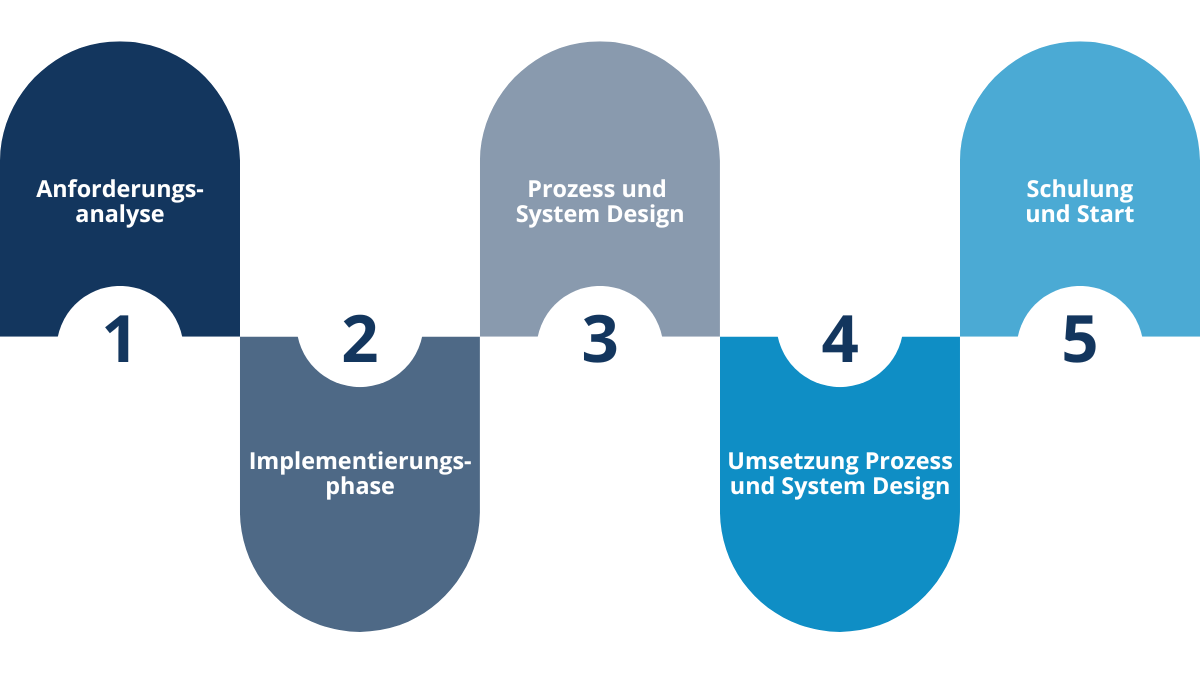
Step 1: The concrete requirements analysis
If you want to start with an ERP implementation, you first need one thing: peace and quiet and plenty of time to think thoroughly!
First, you should assess whether your company can allocate the necessary resources for an ERP project. Keep in mind that implementing an ERP system will tie up some of your employees for months. Can you compensate for this downtime? If not, you should consider extending the ERP system implementation over a longer period.
Once you have reviewed your resources, the next step is requirements analysis. This primarily involves considering what requirements you have for your future ERP system.
Consider two aspects in particular:
- the technical perspective (What technologies are needed in your company?)
- the functional perspective (What tools and features should your ERP system have?)
Do you maintain a requirements specification?
Next, you should clearly write down all your considerations so far. This document will form the basis for selecting your system later in the ERP implementation process.
In addition to the technical and functional requirements analysis, you should also take notes on the following aspects:
- Overview of the company’s technical infrastructure
- General information about the company and the industry
- Timeline and deadlines of your ERP project
Create a shortlist
Once you have completed your requirements specification, you already have a comprehensive foundation with all your requirements and plans for your new ERP system.
The next step is to select the right provider for your project. This step presents a significant challenge for many employers in the vast market of ERP systems. Therefore, we recommend first creating a manageable list of potential ERP partners. This list is also commonly referred to as a shortlist.
Before you begin creating your shortlist, you first need to narrow down the ERP providers. You don’t need to be an expert for this—a simple internet search is usually sufficient. Get an overview of the available ERP providers and note down those that might be suitable for you.
The list of potentially suitable ERP providers represents your pre-selection and is also referred to as the long list.
In the next step, send your requirements specification to all potential suppliers and request their assessment. Pay attention not only to the content of their responses but also to their communication style. Do you receive a standardized or a personalized response? How long did it take to get a response? All these criteria provide important information and form the next selection criterion when creating your shortlist.
If you feel that you’re still missing a lot of information after your initial selection, you can arrange a personal meeting with the vendors. Typically, vendors will present their ERP systems in more detail during these meetings, giving you the opportunity to ask more in-depth questions.
After you have thoroughly reviewed and contacted your pre-selection, the finished document with all suitable ERP providers represents your completed shortlist.
ERP system selection using workshops

After creating your shortlist, you now have a number of potentially suitable ERP software partners in front of you. Nevertheless, the selection process is not yet complete – while the providers on your shortlist may generally be a good fit for your company, you still don’t know which ERP partner best suits you and your specific requirements.
But how can a company find out which ERP partner is actually the best fit? Most employers hold a one- to two-day workshop on ERP to get to know their potential providers better.
This gives ERP providers the opportunity to present their software system and their employees in more detail and to address potential questions and uncertainties of the company.
In order to give providers the opportunity to prepare individually for your needs, they require more in-depth information about your company, your industry and your future plans.
While your requirements specification already serves as a rough guideline and source of necessary information, we still recommend a personal meeting with the respective vendors. Experience shows that a vendor briefing leads to better and more tailored ERP workshops – which in turn can significantly influence your decision when choosing a system.
What criteria influence the choice of an ERP system provider?
Once you have conducted an ERP workshop with all your potential ERP partners, you will be faced with a difficult choice.
Most companies consider costs, in addition to the offerings and features of the providers, as a key decision criterion.
So-called “soft factors” can also have a significant impact on the choice of ERP partner. If you notice personal antipathy between your employees and the ERP team right from the start, you should be wary. Keep all factors in mind if you want to avoid conflicts in the long run!
Step 2: Implementation of the system and employee training

If you have reached this stage, it means that you have chosen a suitable ERP provider and all contractual details have already been clarified – congratulations!
Now the next crucial phase of the ERP implementation begins: the implementation itself.
The primary focus of implementation is the technical implementation of the ERP system and its integration into your internal processes. Your employees will receive appropriate training and workshops on how to use the ERP system.
The specifications
Before implementation can proceed, another workshop is on the agenda. In this workshop, you and your ERP partner will jointly review your requirements specification with regard to your wishes and needs.
This way, you can develop your approach and goals together and avoid potential ambiguities. At the end of the workshop, the results will be documented in a so-called requirements specification.
The specifications document primarily outlines how the ERP provider intends to technically implement the customer’s project.
Once you give the green light, the ERP provider’s technical staff, together with your IT department, will configure the software accordingly in your company and make individual adjustments.
System review and core team training
Once the ERP system has been implemented and technically configured in your company, several control tests will be conducted before the software is finally accepted. It is crucial at this stage that you thoroughly and intensively test the system – negligence here could prove very costly.
During the implementation phase of the ERP system, the training of the main responsible employees also takes place simultaneously.
A fundamental distinction is made between basic training for the core team and employee training. Both training sessions take place at different times.
The basic training
The initial training takes place right at the beginning of the implementation phase. Here, the ERP provider gives the future main users and IT staff a general overview of the system and informs them about the most important functions and tools. The goal is to provide the main users with such comprehensive information that they can independently train their colleagues on the system in the future.
Step 3: Process and system design
In the third phase of ERP implementation, the focus is on the design of the ERP system. This primarily involves determining how the work processes of the individual business units can be most effectively mapped within the ERP system.
Likewise, the functional and process descriptions are documented here, and necessary interfaces and adjustments are specified in detail.
Step 4: Implementation of process and system design
In the next step, the individual processes of the ERP system are configured and tested accordingly. At the end of the configuration, relevant data is migrated and transferred to the ERP system. Following this, the crucial integration test takes place, which can be considered a test run for the entire process.
The team is responsible for confirming the successful completion and thus the successful implementation of the process.
Step 5: Training and launch of the ERP system
The final step focuses primarily on training and the launch of the ERP software.
Employee training usually takes place before the actual data transfer at the end of the ERP implementation.
However, the training of employees is not carried out by the ERP providers, but by the already trained main users and IT staff. Therefore, this is an internal training course.
There are several reasons why internal training is beneficial at this stage. Firstly, it promotes knowledge transfer within the company. This leads to the ERP system being integrated more quickly and effectively into the entire organization. Secondly, it prevents you from becoming overly dependent on your ERP software partner.
Once your employee training is successfully completed, your ERP implementation is considered complete. The system has been technically implemented, and your employees are ready to use it. Now, the system is being commissioned, during which your company will continue to receive online support from the ERP providers should any questions arise. From now on, you can fully utilize your new ERP solution!
How long does an ERP implementation take?
As a general rule: Every ERP implementation is as individual as the company itself, so it is often impossible to make a concrete statement at this point.
Company size, available resources, the company’s industry, and available capacities are just some of the framework conditions that can have a major impact on the implementation time.
Another crucial factor is the company’s existing infrastructure. If some processes are already covered by an ERP solution, the existing workflows between the company and the provider, for example, need to be re-examined.
How much effort is involved?
Ideally, the internal project managers of the ERP system would focus exclusively on the successful implementation of the software.
As a rule, these employees are also responsible for other areas of the company and are therefore indispensable in everyday work.
Generally speaking, the success of an ERP implementation depends significantly on the internal team collaborating and supporting each other from the outset. Your employees should work together to transfer internal processes to the new system in order to optimize operations.
As a general rule, experience suggests that approximately 75 percent of the working time of the main person responsible for implementing the ERP system should be dedicated to it. This helps avoid unnecessary waiting times and delays. However, it should be noted that the actual workload can vary considerably between days or weeks, depending on the phase of the project.
Potential difficulties during ERP implementation
In the area of ERP implementation, there are numerous stumbling blocks that can cause the implementation of an ERP system to fail.
Below we present the most common forms of misconduct and show you how to avoid them in your company.
Unclear goals
As mentioned above, we recommend conducting a comprehensive current state analysis beforehand to define clear objectives for the ERP implementation. Clarify in advance: What do you want to achieve with the ERP system? And how do you intend to achieve it?
Low flexibility and poor change management
During the course of the project, new developments often occur that differ from the requirements defined at the beginning of the project.
When this occurs, it constitutes a so-called change event, which should be moderated accordingly. Both the provider and the company now require flexibility, effective change management, and creativity to find a satisfactory solution for both sides.
The complexity of ERP implementation is underestimated.
Every ERP system, like the company itself, is unique and can vary in its system design and features.
If the ERP system is to be implemented across all departments of the company, the necessary features and tools are usually complex to implement. This requires a certain willingness to compromise on the part of both the provider and the company.
As a company, you also need to be aware that with standard-capable ERP systems, it may not be possible to implement all individual processes as desired.
Taking employee training too lightly
For many employees, the training is just the beginning of the process of learning the system: A comprehensive understanding of the software program is often crucial for the success of the ERP project and should therefore not be done superficially.
Therefore, it is important to allocate sufficient resources for technical support. Employees first need to familiarize themselves with the system and the new workflows – this takes time, especially if an external consultant is no longer available.
While extensive training in this area requires corresponding resources, it enables your company to fully exploit the advantages of the system.
Poor data quality
Ensure that all relevant data sets for the ERP implementation are available well in advance of the project! Data migration can be complex and time-consuming if the necessary data is unavailable or incomplete.
Mutual misunderstandings arise.
When choosing an ERP provider, you must be aware that you will spend a lot of time together until successful implementation.
Therefore, take sufficient time to become a well-coordinated team with your provider! Make sure you are on the same page.
Especially with IT solutions, the same terms can often have different meanings. Similarly, it happens that employees in production describe the same situation differently than employees in IT. The result: misunderstandings that can lead to disagreements within the team.
Take your time to avoid these mistakes. Ideally, review the requirements from the specifications document thoroughly with all involved parties beforehand.
Final checklist: Have you thought of everything important?
It’s easy to lose track of things in a large project. Therefore, we’ve compiled an overview of the most important tasks and to-dos for implementing an ERP system:
Internal preparation
- Define your goals and requirements specifically in a requirements specification.
- Identify a project team, including a project manager, for the ERP implementation.
- Choose a suitable ERP software for your project.
System analysis
- Analyze your business processes together with your ERP provider.
- Create a requirements specification.
- Conduct a gap analysis
implementation
- Development of modifications and system adjustments to the software
- Install software and, if necessary, hardware
- Conduct initial training sessions for primary users
- Prepare, execute, and control data migration
- Conduct system tests
Training
- conduct further extensive training for main users
- Check whether users also demonstrate their everyday tasks with the ERP system.
- Have other employees trained by the main user
- Planning and implementing change management
Conclusion: Success through clear goals
Every company is unique and has its own individual internal structures. Accordingly, every ERP implementation presents its own unique challenges.
Nevertheless, the process of an ERP implementation in any company can generally be broken down into a few steps, some of which overlap:
- Analysis of the system and the company
- The implementation of the system
- The employee training
- The system’s live launch
Experience shows that companies that define clear goals from the outset and meticulously pursue them are significantly better positioned at the end of the ERP implementation than their corresponding comparison groups.
It is also absolutely essential for all ERP implementations that a functional team and good collaboration between the company and the ERP provider are indispensable for successfully carrying out the steps described above. Avoid misunderstandings and disagreements by strengthening communication from the outset.
While a successful ERP system requires a large amount of personnel, time and financial resources during its implementation, it can reduce your operating costs, accelerate production cycles and significantly optimize your customer service in the long term.
If you have any further questions or uncertainties, your ERP partner will be available around the clock even after the successful implementation of the system and will fully support you in case of any difficulties that may arise with the ERP solution.