Document Management System (DMS)
An implemented document management system enables a new, completely digital way of working in your company. Experience shows that many wholesale businesses still operate in a very analog manner. Numerous printouts, order lists, and the like not only harm the environment but also reduce the efficiency of work processes.
A document management system therefore helps you transition from analog documents to digital workflows. Each document is stored centrally by the system. This way, nothing gets lost and everyone has access to all relevant data at any time.
Business Intelligence Modul
ERP software collects all of a company’s data in a central database. A BI module helps you systematically analyze and measure all data and processes in real time. This not only creates transparency but also increases your company’s effectiveness.
But that’s not all: By analyzing past and current data, you will be able to make predictions about customer behavior in the future. Which product will be in higher demand? At what point will customer traffic increase? All these questions can be answered very precisely, provided your database is large enough.
Accounting and Controlling
ERP software also supports you in the accounting and controlling areas of your wholesale business. With the appropriate module, your invoices can be automatically checked and assigned to the correct cost center.
This automation can also be used for your own invoicing. This saves you both time and personnel resources. Furthermore, an ERP system can generate various financial reports. This also helps you make validated decisions in controlling.
Integration of a B2B webshop
Implementing a modern ERP system makes it easy to integrate your online shop into the central system. Integrating the webshop into the ERP system offers a number of advantages. For example, data transfer allows for reliable information about product delivery quantities at any time.
Warehouse management module
An organized and efficiently managed warehouse saves time and personnel resources. However, to manage your warehouse effectively, your ERP system needs as much information as possible. How much do the products weigh? What are the dimensions of the components?
Furthermore, an ERP system also allows for the analysis of inventory levels.
Wholesalers always strive to ensure the availability of their products. This often requires large inventories of large quantities, which is associated with considerable costs.
Analyzing data allows for the identification of seasonal fluctuations in specific product categories. This enables better planning and helps to counteract bottlenecks and poor financial decisions.
Purchasing management module
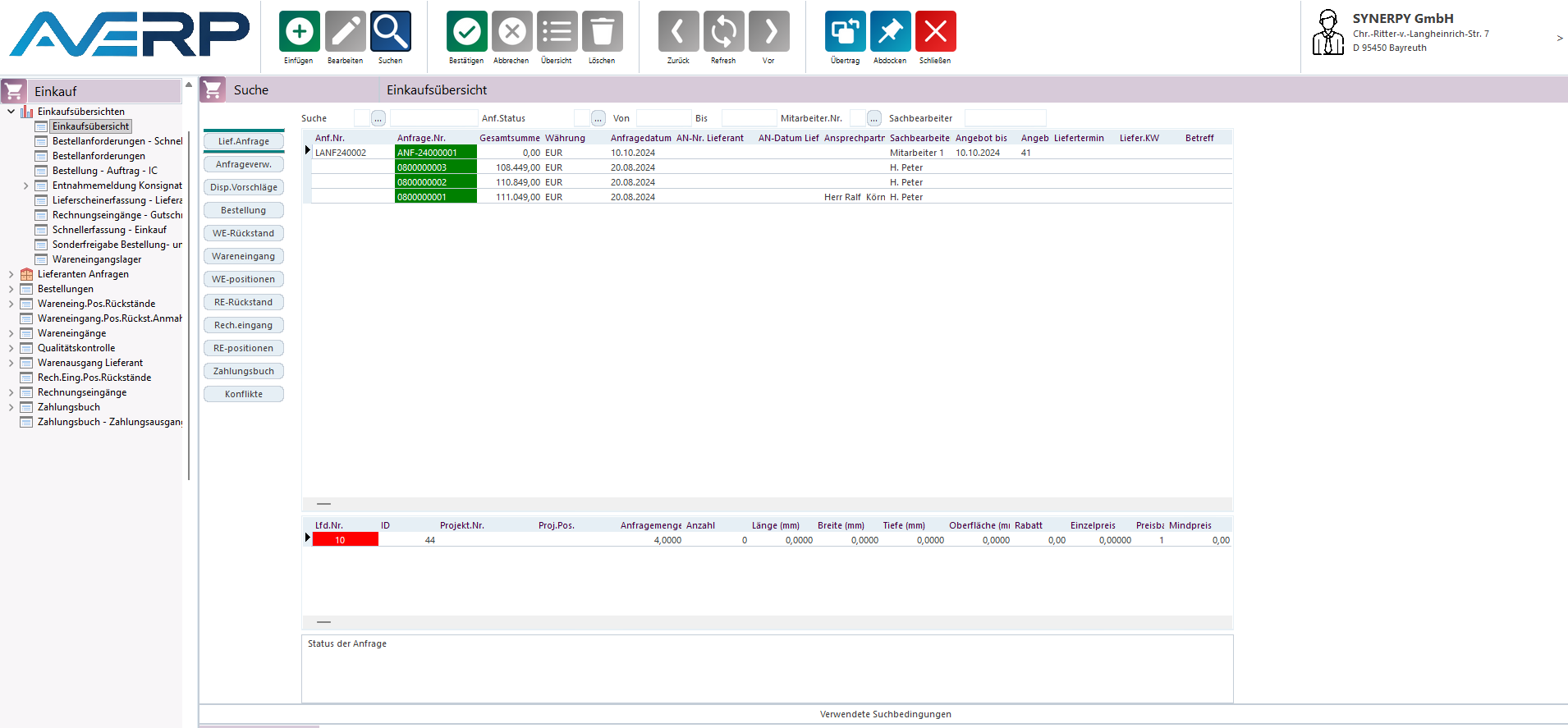
Targeted purchasing management helps to improve and streamline work processes. Each item can be linked to an alternative supplier. If the primary supplier experiences a shortage and no subsequent delivery is possible, the system automatically suggests another supplier.